
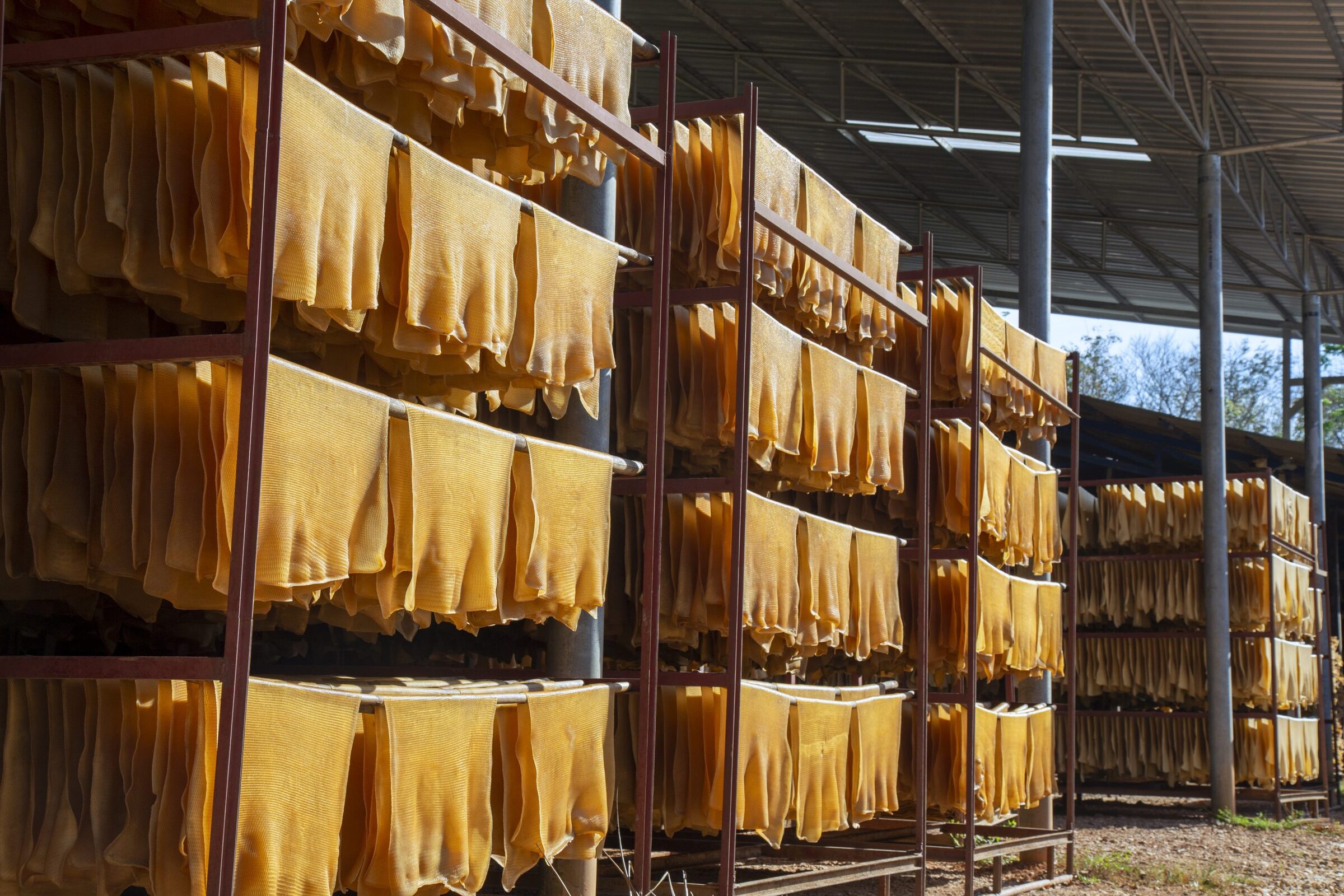
Choosing between RSS and TSR for tyre carcass compounds
Both grade families are natural rubber from estate cooperatives. The grading method, supply chain, and downstream compounding behaviour are where they part ways.
2026-05-14 · 6 min read · By Above Infinity sourcing desk
Walk into any compounding plant in Southeast Asia and you will find both RSS and TSR feeding the mixers. They are both natural rubber, both originate from Hevea brasiliensis, and both come out of estate cooperatives. The interesting question is when to choose one over the other.
The short answer
RSS is graded by eye. TSR is graded by lab. That single difference cascades into every aspect of how the rubber moves through your supply chain.
How RSS is graded
Ribbed Smoked Sheets are graded visually, against the TRA Green Book International Standards, using physical attributes:
- RSS 1, the cleanest. No bubbles, no stain, no mould, no over-smoking.
- RSS 2, slight bubbles, faint specks permitted.
- RSS 3, small bubbles, slight stain or mould allowed. The workhorse of tyre carcass mixes.
- RSS 4, bubbles up to 4 mm permitted. Mechanical rubber goods and re-treads.
- RSS 5, heavily-coloured or partially virgin-bark sheets. Lower-grade extrusion, mats, dampers.
The grading method has a real advantage: it can be done at the smallholder co-op without lab equipment. It also has a real disadvantage: visual grading is judgement-dependent, and a sheet that looks RSS 3 to one inspector may look RSS 4 to another.
How TSR is graded
Technically Specified Rubber goes through a laboratory grading process, block-form natural rubber tested against ISO 2000. Every grade has defined limits on:
- Dirt content (% by weight, sieved at 45 μm)
- Ash content
- Nitrogen content (proxy for protein)
- Volatile matter
- Plasticity Retention Index (PRI)
- Mooney viscosity (ML 1+4 at 100°C)
The four origin grades, SMR (Malaysia), SIR (Indonesia), STR (Thailand), SVR (Vietnam), all use the same ISO 2000 framework but operate independent national grading labs.
SMR 20 is the highest-volume natural rubber line in the world and the de facto reference for tyre-grade NR.
Tyre carcass compounding, RSS 3 or SMR 20?
Both are used for tyre carcass mixes. Here is how to choose:
| Criterion | RSS 3 | SMR 20 |
|---|---|---|
| Grading consistency | Variable (visual) | Consistent (lab) |
| Mooney viscosity declared | No | Yes (per COA) |
| Dirt limit declared | No | Yes (≤ 0.20% for SMR 20) |
| Form | Sheets (need cutting) | 33.3 kg bales (mill-ready) |
| Direct mill feed | Less suited | Yes |
| Volume availability | Smaller batch sizes | Container-scale |
| Premium-tyre suitability | Limited | Yes, most major tyre majors use it |
When RSS still wins
For some specialty applications, RSS is preferred:
- Engineering goods, conveyor belt covers, RSS 1 has very low impurity load and a distinctive cure profile.
- Cement-bonded products, sheets are easier to layer than bales for some lamination processes.
- Heritage compounds, some compounds developed decades ago were specified around RSS and never moved.
Practical sourcing notes
If you are starting a new tyre-grade programme today, SMR 20 is almost always the right answer. The certificate of analysis travels with the consignment and your mixer team can lock in their cure curves without surprises.
If you already buy RSS and need to scale, the safest bridge is to dual-source: keep your RSS supplier for known compounds, qualify SMR 20 for new programmes, and watch your Mooney variance drop.
Either way, ask for COAs on every shipment, set Mooney targets explicitly, and audit dirt and ash quarterly. Variance is the enemy of compound predictability.
Sourcing through Above Infinity
We supply both. RSS comes from Malaysian and Indonesian estate co-operatives, palletised under controlled conditions; TSR comes direct from Malaysian Rubber Board registered factories (SMR), Sumatra-origin processors (SIR), Thai concession blocks (STR), and Vietnamese facilities (SVR). FCL minimums, mixed-origin containers on request, and offtake programmes for repeat buyers.